If you’re a business owner in what we call the SME segment—that is, small and medium-sized enterprises—it’s quite possible thatcollective bargaining agreements seema bit complicated. That’s not surprising. You can’t be an expert on everything, and you probably don’t have your own HR department to handle this.
In this article, we address some of the most common questions and also examine the pros and cons of a collective bargaining agreement.
The collective bargaining agreement is part of what we in Sweden call the Swedish Model, which means that both sides of the labor market—employees and employers—share responsibility for ensuring both competitive businesses and good working conditions. As an entrepreneur, you are expected to act responsibly and make long-term investments in your employees. The latter, in turn, ensure, among other things, a fair wage and working conditions that are standard within the industry.
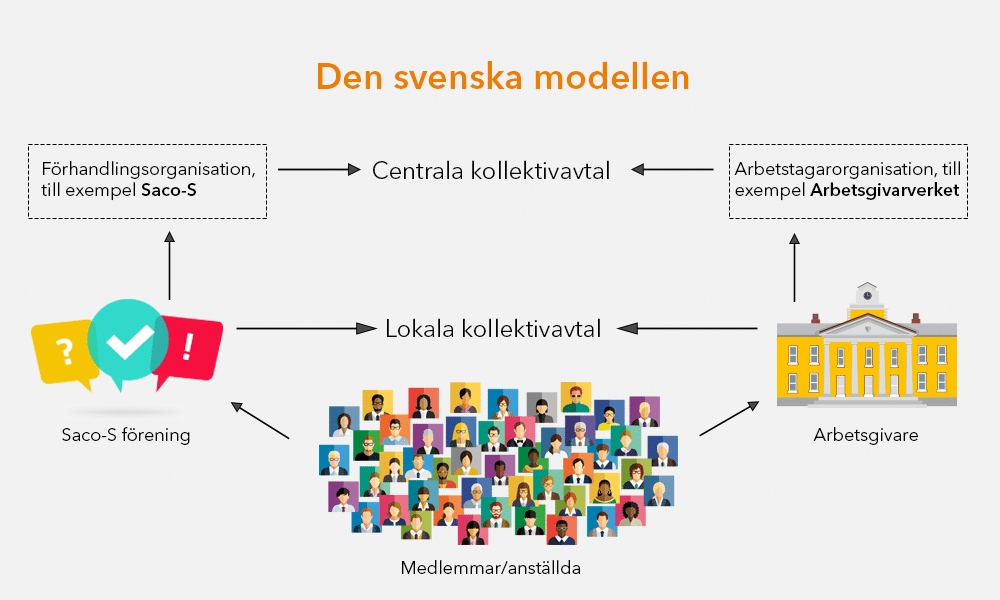
All of the above is governed by the collective bargaining agreement.
How do you negotiate a collective bargaining agreement?
When it comes to joining a collective bargaining agreement, as an employer you have two options: you can join through anemployers’ association or through asupplementary agreement.
A reference agreement means that you and the union agree to follow the agreements in effect in the relevant industry. When it comes to employee benefits and terms of employment, there is no real difference between a collective bargaining agreement and a reference agreement.
Being covered by a framework agreement entails the same obligations as a collective bargaining agreement, but it can be more expensive and more complicated for you as an employer. For example, you’ll have to pay for any legal advice yourself, and some employer organizations charge additional fees for membership.
Is it a given that the company should have a collective bargaining agreement?
Industry-specific collective bargaining agreements provide long-term, stable rules that are determined by the industry’s employer organizations and labor unions themselves. It is worth keeping in mind that Swedish law always takes precedence over collective bargaining agreements, provided that the law is not discretionary.
Here are a few more benefits:
- Under the collective bargaining agreement, pension contributions provide more pension for your money, as collectively negotiated pensions have fees that are up to 65% lower.
- Workers’ compensation insurance is part of a collective bargaining agreement and provides compensation to the injured party without determining who is at fault for the workplace injury. Occupational safety efforts aim to prevent injuries rather than assign blame or hold anyone accountable. Without workers’ compensation insurance, a person who suffers a workplace injury has no way of receiving compensation without suing the company.
- The mediation system provides a cost-effective and expeditious means of dispute resolution, with very few disputes ending up in court.
- Working time agreements for the industry contain rules that are tailored to individual companies and more flexible than those in the mandatory Working Hours Act, as the Act is superseded by collective bargaining agreements.
- Option to enter into an agreement on the order of priority for layoffs. In the absence of a collective bargaining agreement, the employer must comply with the provisions of the Employment Protection Act.
- It is easier to obtain a work permit when you are covered by a collective bargaining agreement. This ensures that all employees are covered by at least the minimum acceptable terms of employment; in other words, a collective bargaining agreement serves as a guarantee to the Swedish Migration Agency.
Are there any drawbacks?
Setting wage levels for employees through collective bargaining agreements can mean that individual employees are not given the opportunity to negotiate and increase their own wages at a specific time. Under the Swedish model, wage increases typically occur once a year.
Collective bargaining agreements can lack flexibility. These agreements are negotiated based on the operations of large companies. In small businesses, it is common for employees’ roles to vary in importance and be unique to the company.
Often, the business operates based on employee performance. Given that everyone must be treated equally under the collective bargaining agreement, there is therefore limited scope to adapt the rules on an individual basis.
Although this should certainly not be viewed as entirely negative, a collective bargaining agreement can lead to reduced competitiveness, since it prevents employers from hiring staff and offering them certain special terms and conditions beyond what the agreement stipulates.
Bonuses or other employee benefits may be more difficult to offer. Depending on the industry you operate in, this could make your company less competitive as an employer.